![YADABA FINAL LOGO[1460]](https://yadabacomms.com/wp-content/uploads/2021/07/YADABA-FINAL-LOGO1460-1.png)
Communication Ethics When Every Message Leaves a Trail

Preparing for the Crisis You Hope Never Comes
August 10, 2026
Measuring Communication ROI: Proving the Value Beyond Visibility
August 17, 2026
A communication decision can take five minutes to make and years to explain.
A team member forwards an internal email to the wrong person. A social media manager posts before checking the facts. A company responds to an unhappy customer publicly and, in trying to defend itself, reveals more than it should.
None of these situations necessarily starts with bad intentions. They often begin with speed, pressure, poor judgement, or the assumption that “it’s just a post.”
Ethical communication is not simply about avoiding lies. It is about making responsible choices about what we say, what we share, what we leave out, and how our communication affects other people.
The digital environment changes the consequences
Digital communication has made it easier to publish quickly and reach large audiences. It has also made mistakes harder to contain.
A message written for ten people can reach ten thousand. A private screenshot can become public. An inaccurate statement can continue circulating long after it has been corrected.
Organisations therefore need to think beyond, “Can we publish this?”
A better question is: “Should we publish this, and what could happen if we do?”
That question matters particularly when communication involves customers, employees, partners, journalists, communities or public institutions.
Privacy is another area where good intentions can create problems. An organisation may want to share a customer’s success story, employee achievement or community activity. But permission should not be assumed simply because the content makes the organisation look good.
There is also the issue of transparency. If information is uncertain, say so. If a mistake has been made, correcting it quietly may not be enough. And if an organisation is responding to criticism, the goal shouldn’t be to “win” the conversation. It should be to provide accurate information while protecting trust.

Ethics should be part of communication planning
One of the most useful changes an organisation can make is to stop treating ethics as something considered only after a problem occurs.
Before publishing sensitive content, ask:
Is the information accurate and properly verified?
Do we have the right to share it?
Could someone be unfairly exposed or harmed?
Are we giving people enough context to understand the message?
Would we be comfortable defending this decision publicly?
These questions don’t have to slow communication down. With clear approval processes, content guidelines and trained communication teams, they can become part of normal decision-making.
At Yadaba Communications, we approach communication with this wider responsibility in mind. Strategic communication isn’t only about crafting a good message. It involves understanding stakeholders, anticipating reactions, protecting reputation and knowing when restraint is the better communication decision.
That applies across public relations, media engagement, corporate communication, branding and crisis situations.

The strongest communication is not always the message that gets the most attention. Sometimes, it is the message that earns the most trust.
If your organisation needs help developing clearer communication practices, managing reputation or responding to sensitive communication challenges, Yadaba Communications would be glad to help.
Email: info@yadabacomms.com | yadabacomms@gmail.com
Phone: 0530505004 | 050 590 2672
5 Practical Tips on Communication Ethics
1. Verify before you publish.
Check names, figures, quotes, images and claims before content goes public.
2. Ask for permission.
Don’t assume that having access to information means you have permission to share it.
3. Protect private information.
Review screenshots, documents, photos and customer details for information that shouldn’t be exposed.
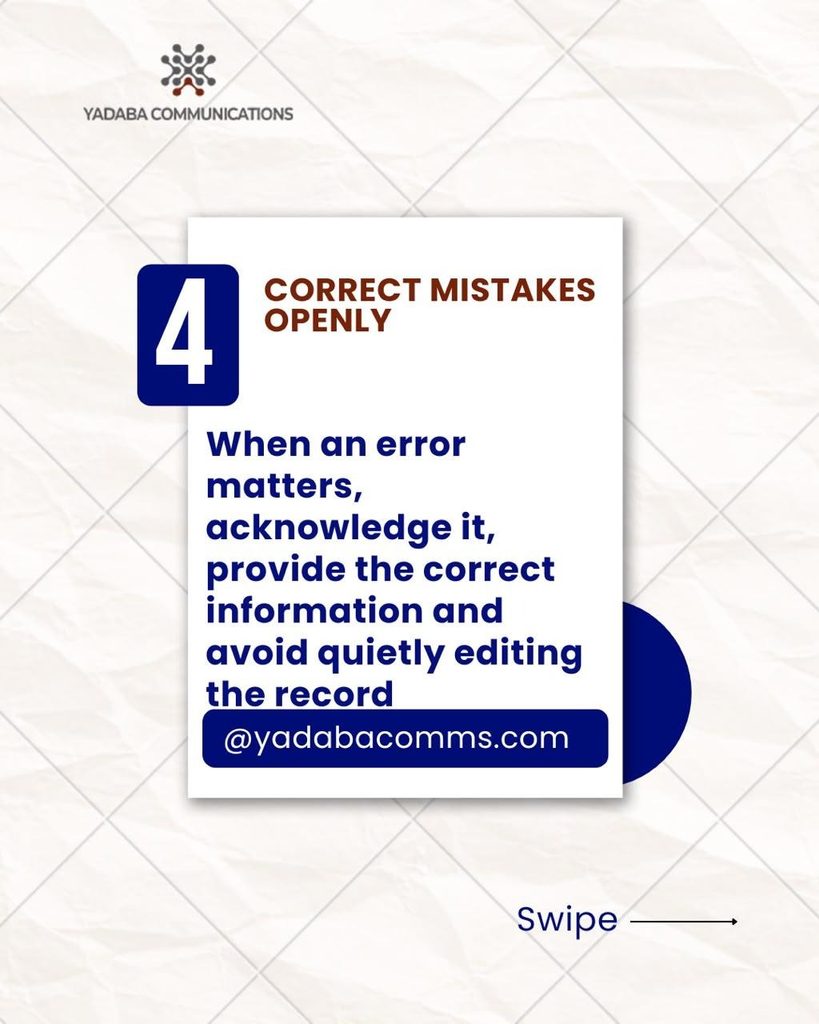
4. Correct mistakes openly.
When an error matters, acknowledge it, provide the correct information and avoid quietly editing the record.
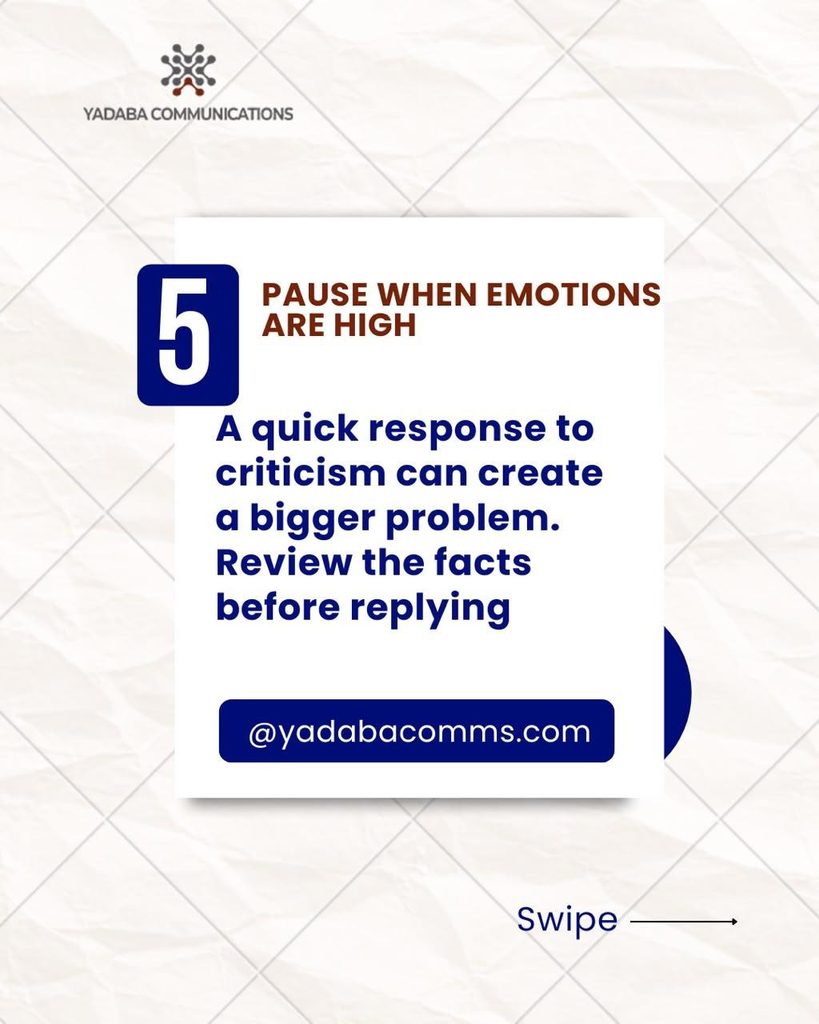
5. Pause when emotions are high.
A quick response to criticism can create a bigger problem. Review the facts before replying.
Social Media Caption
Good communication isn’t only about knowing what to say. It’s also knowing what shouldn’t be shared, what needs to be checked, and when responding quickly could do more harm than good.
Our latest Tips breaks down five practical ways organisations can make better communication decisions online.
For practical support with public relations, corporate communication, reputation management and sensitive communication matters, connect with Yadaba Communications:
info@yadabacomms.com | yadabacomms@gmail.com
0530505004 | 050 590 2672
#YadabaComms #PublicRelations
Tips Cards